
How your documents move
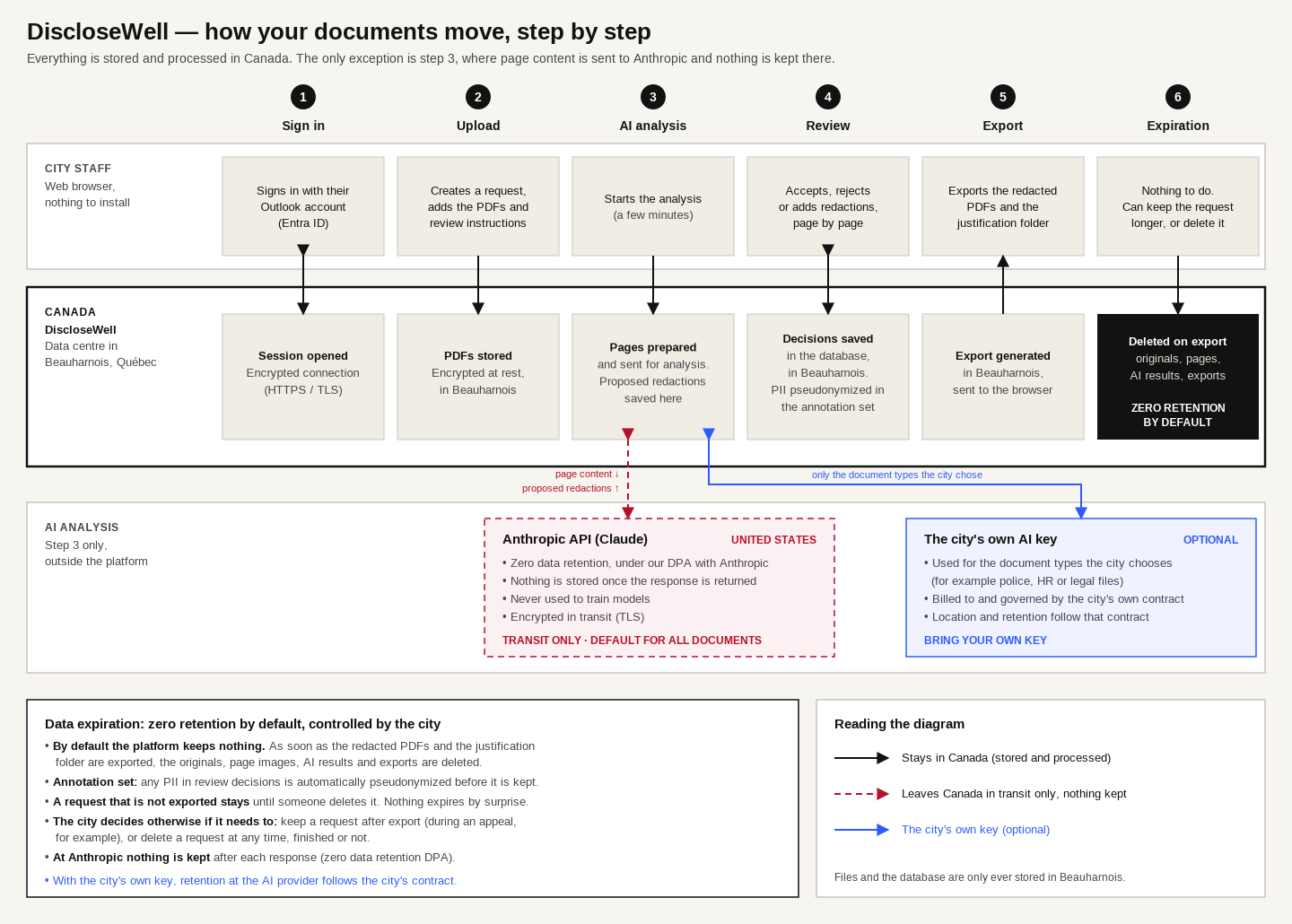
Documents are stored and processed in Canada, in a data centre in Beauharnois (Québec). The only exception is the AI analysis. The document is never sent whole: it stays on DiscloseWell's servers, and only a few fragmented excerpts are sent to Anthropic's API. They come straight back, and nothing is kept there.
Original PDFs, exports, review decisions and the database stay in Beauharnois, encrypted at rest.
Page excerpts go to the Anthropic API under a zero data retention DPA. Nothing is stored there or used for training.
Exporting a request deletes its files. The city can keep a request longer, or delete one at any time.
- 01Sign inCity staff
Signs in with their Outlook account (Entra ID), from a web browser.
Canada · BeauharnoisSession openedEncrypted connection (HTTPS / TLS).
— Stays in Canada - 02UploadCity staff
Creates a request, adds the PDFs and review instructions.
Canada · BeauharnoisPDFs storedEncrypted at rest, in Beauharnois.
— Stays in Canada - 03AI analysisCity staff
Starts the analysis, which takes a few minutes.
Canada · BeauharnoisPages preparedFragmented excerpts are sent for analysis. The proposed redactions come back and are saved here.
Outside CanadaUnited States · transit onlyAnthropic API (Claude)- Zero data retention, under our DPA
- Nothing stored once the response is returned
- Never used to train models
- Encrypted in transit (TLS)
OptionalThe city's own AI key- For the document types the city chooses
- Governed by the city's own contract
- 04ReviewCity staff
Accepts, rejects or adds redactions, page by page.
Canada · BeauharnoisDecisions savedIn the database, in Beauharnois. Any PII is pseudonymized in the annotation set.
— Stays in Canada - 05ExportCity staff
Exports the redacted PDFs and the justification folder.
Canada · BeauharnoisExport generatedIn Beauharnois, then sent to the browser.
— Stays in Canada - 06ExpirationCity staff
Nothing to do. Can keep the request longer, or delete it.
Canada · BeauharnoisDeleted on exportOriginals, pages, AI results and exports. Zero retention by default.
— Stays in Canada
- Stored and processed in Canada
- Leaves Canada in transit only, nothing kept
- The city's own key
What is AI, and what is not.
The legal framework is deterministic. The statutes, their sections and their hierarchy (federal, then provincial, then case law) are built into the system. A given jurisdiction always gets the same rules, and every redaction cites its section. None of this is left to the AI.
The analysis is done by a reasoning agent. To read the documents and propose redactions, an AI agent reasons in several steps, from the legal framework and the city's instructions. It is neither a single call to a model nor a search in a document base (RAG).
A person decides. Every proposal is accepted, rejected or corrected by city staff. Nothing is exported without that review.
A system that learns with your clerks
Two cities do not apply the same law the same way, so the system adapts to yours instead of applying an average. Every review decision sharpens the next proposals for your city. The system picks up your way of working without anyone piling up rules by hand, and without ever training a model on your documents.
Decisions are kept in the city's annotation set, pseudonymized, in Beauharnois, and serve as reference points in later analyses. The AI model itself does not change.
Nothing is kept by default. The city decides.
Zero retention by default. As soon as the redacted PDFs and the justification folder are exported, the platform deletes the originals, page images, AI results and exports.
The annotation set keeps no original PII. Review decisions feed an annotation set. If a decision contains personal information (PII), it is automatically pseudonymized before it is kept there.
Nothing expires by surprise. A request that has not been exported stays until someone deletes it.
The city decides. When it needs to (during an appeal, for example), the city can keep a request after export. It can also delete a request at any time, finished or not.
At Anthropic, nothing is kept. Under our zero data retention DPA, inputs and outputs are not stored once the response is returned, and are never used to train models.
The city's own AI key
A city can give us its own AI key for the document types it chooses, such as police, HR or legal files. Those documents are analysed through the city's own account instead of ours. Billing, data location and retention at the AI provider then follow the city's own contract.
Every other step (storage, review, export, expiration) stays as described above, in Beauharnois.